The Tesco recruitment process is highly standardised, designed to move candidates from online application to the shop floor in under a month. If you understand the automated screening tools and have your compliance documents ready, you can easily beat the 30-day average. When comparing shift patterns and situational judgement tests across High Street Retail & Supermarkets hiring guide, Tesco’s timeline is one of the most predictable.
You will not face trick questions or multiple assessment centres for standard store roles. The process tests basic retail competencies, your shift availability, and your legal right to work in the UK.
The 30-Day Tesco Hiring Timeline
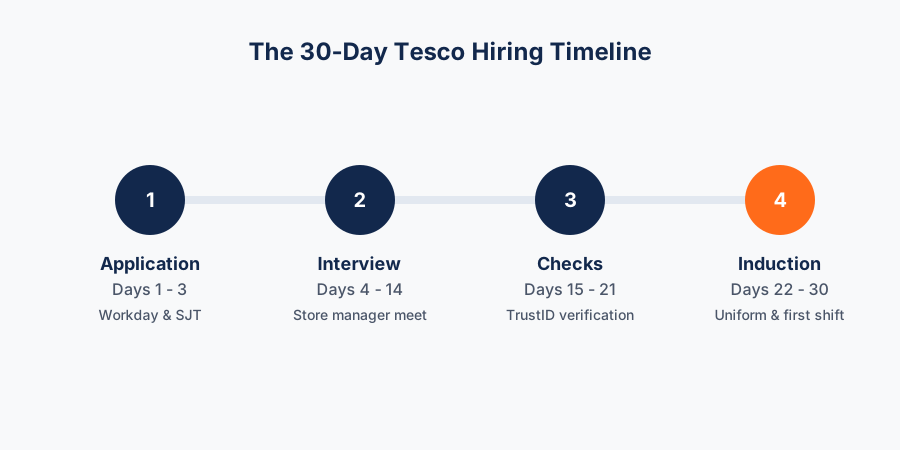
This timeline illustrates the standard four-week progression from submitting your initial Workday application to completing your Day 1 store induction. Delays in this process almost exclusively occur during the background check phase when candidates fail to provide correct right-to-work documentation promptly.
Stage 1: Online Application and Pre-Screening
Tesco uses the Workday applicant tracking system for all store and distribution roles. The initial application takes less than ten minutes and requires basic contact details, your employment history, and your shift availability. You must upload an up-to-date CV, though the system extracts the data automatically.
The most critical part of this stage is the availability matrix. Tesco hires to fill specific gaps in their store rotas. If a store needs a weekend night-shift worker and you only select weekday mornings, the system will auto-reject you regardless of your experience.
At this stage, you must also declare your right to work in the UK. Have your passport, biometric residence permit (BRP), or share code ready. Entering incorrect details here will flag your application and stall the background checks later.
Stage 2: The Tesco Discover Assessment
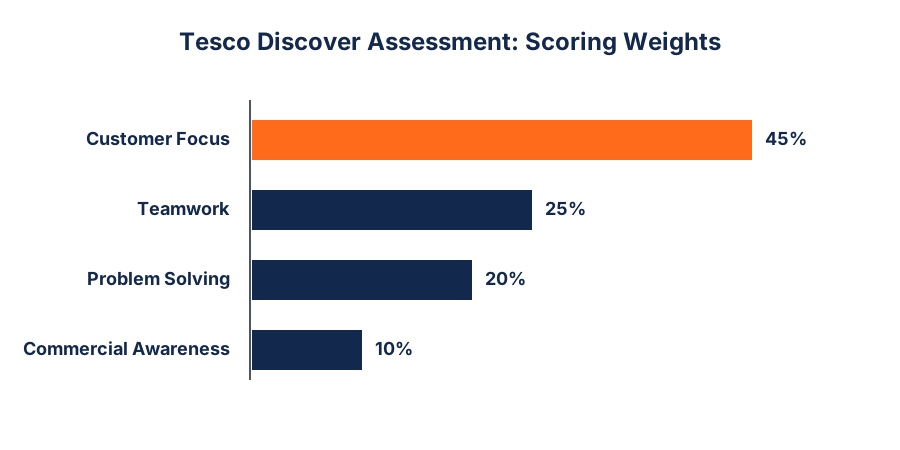
If your availability matches the store's requirements, you will immediately receive an email invitation to complete the Tesco Discover assessment. This is a situational judgement test (SJT) that takes roughly 15 to 20 minutes to complete. The graphic above illustrates the core competencies the system weighs most heavily when evaluating your responses.
The assessment presents you with everyday retail scenarios and asks you to rank multiple-choice responses from most effective to least effective. The system scores you primarily on Customer Focus, Problem Solving, and Teamwork.
A customer approaches you looking for a specific brand of coffee that is out of stock on the shelf. You are currently halfway through restocking the busy biscuit aisle and your manager has asked you to finish it quickly. What do you do?
| What they ask | What they actually want to hear |
|---|---|
| How do you balance a manager's task with a customer's immediate request? | Customers always come first. You should pause the restocking task, physically escort the customer to the coffee aisle, and check the stockroom if necessary. |
| How do you handle conflicting priorities on the shop floor? | You communicate effectively. You help the customer, then inform your manager if the interruption will significantly delay your assigned aisle task. |
Do not overthink the scenarios or try to guess a complex operational procedure. Tesco wants candidates who demonstrate common sense and default to helping the customer over finishing a routine task.
Stage 3: The In-Store Interview
Candidates who pass the assessment are invited to an in-store interview. This is typically a 30 to 45-minute face-to-face conversation with a Line Manager or the Store Manager. You will be asked to bring your original right-to-work documents to this interview for physical verification.
The interview is competency-based, drawing heavily on your past experiences. Managers are scoring your Resilience, Adaptability, and Communication. They want evidence that you can handle a fast-paced environment and deal with the general public calmly.
Tell me about a time you had to deal with an angry customer or a difficult colleague. How did you resolve the situation, and what was the outcome?
| What they ask | What they actually want to hear |
|---|---|
| Can you handle conflict without escalating the situation? | Evidence of active listening, remaining calm under pressure, and not taking customer frustration personally. |
| Do you know when to seek help? | Acknowledgement of store policy. You tried to resolve it yourself, but knew exactly when to involve a shift leader or manager to diffuse the situation. |
Answer using the STAR method (Situation, Task, Action, Result). Keep your examples concise. Managers conduct multiple interviews a week and appreciate candidates who get straight to the point while clearly outlining their personal contribution to the outcome.
Stage 4: Right-to-Work Checks and Induction
Once you receive a verbal offer, the clock starts on compliance. Tesco uses a third-party provider, often TrustID, to verify your right-to-work documents and conduct basic background and reference checks. This is where the 30-day timeline can stretch if you are unprepared.
Respond to the background check email immediately. Upload high-resolution, glare-free photos of your documents. If you are using a Home Office share code, ensure it is generated for employment purposes and is currently valid.
Upon clearance, you will be invited to a welcome induction. This involves ordering your uniform, completing mandatory health and safety e-learning modules, and touring the store. You are paid for this induction day, and it marks your official start on the Tesco payroll.
Culture and Values
Tesco’s entire recruitment framework is built around three core values: "No one tries harder for customers", "We treat people how they want to be treated", and "Every little helps". These are not just marketing slogans; they are the literal rubrics managers use to score your interview answers.
When answering questions, explicitly tie your actions back to these values. Emphasise small, proactive steps you take to improve a situation, reflecting the belief that every little helps. Highlight your commitment to inclusive, respectful teamwork to show you treat people how they want to be treated.
Above all, demonstrate an unwavering commitment to the shopper. In any situational judgement test or interview scenario, the action that prioritises the customer's experience will always be the highest-scoring answer.